The Ethiopia Investment Visa (IV) is a special-entry visa for foreign nationals who plan to invest in or already hold investments in Ethiopia, issued through the Ethiopian Investment Commission (EIC) and the Immigration and Citizenship Service (ICS). Fees range from $62 for a 30-day single-entry to $502 for a 12-month multiple-entry visa, and the application can be initiated online via evisa.gov.et.
Ethiopia actively encourages foreign direct investment in sectors such as manufacturing, agriculture, energy, ICT, and tourism. If you intend to establish a business, fund a project, or participate in a joint venture in Ethiopia, the Investment Visa is the correct category – not the Business Visa (BRV), which is reserved for short-term meetings and conferences.
This guide explains who qualifies for an Investment Visa, what documents you need, how the fees are structured, and the step-by-step application process through the official portal.
What Is the Ethiopia Investment Visa?
The Ethiopia Investment Visa (IV) is a dedicated visa category under the Ethiopian Immigration and Citizenship Service for foreign nationals engaged in or actively exploring investment opportunities in the country. Unlike the tourist visa or the standard business visa, the Investment Visa is tied to documented investment activity or a formal letter of intent from the Ethiopian Investment Commission.
The IV is designed for:
- Foreign investors establishing new companies or factories in Ethiopia
- Shareholders and directors of foreign-invested enterprises
- Individuals exploring investment opportunities with EIC support
- Participants in Ethiopia’s Special Economic Zones (SEZs)
- Professionals engaged in long-term investment consulting
The Investment Visa is not a work visa. Holders cannot take up employment with an Ethiopian organization. If your investment involves day-to-day operational management requiring a work arrangement, you will also need a work visa (WV or GIV) in addition to or instead of the IV.
Ethiopia Investment Visa Requirements
You must prepare the following documents before applying:
Core Documents:
- A valid passport with at least 6 months of remaining validity from your intended entry date
- A recent passport-size color photograph (digital scan, JPEG or PNG format)
- A scanned color copy of your passport bio-data page
- A support letter from the nearest Ethiopian Embassy or Consulate confirming your investment purpose
- A letter from the Ethiopian Investment Commission (EIC) confirming your investment activity or intent
- A reference code registered by the inviting party on the e-Visa portal
Additional Requirements:
- A valid email address for receiving the e-Visa approval notification
- A credit or debit card for online payment (Visa, MasterCard, American Express, Google Pay, Alipay, WeChat Pay, or Union Pay)
- Proof of investment activity (investment permit, trade license, or EIC registration certificate)
The EIC letter is the most critical document. Without confirmation from the Ethiopian Investment Commission, your application will be categorized as a standard business visa. For general document guidance, see our Ethiopia visa requirements checklist.
Ethiopia Investment Visa Fees (2026)
Investment visa fees follow the same structure as other long-stay visa categories. All fees are in USD and paid online during the application process.
| Entry Type | Duration | Fee (USD) |
|---|---|---|
| Single Entry | 30 Days | $62 |
| Multiple Entry | 90 Days | $152 |
| Multiple Entry | 6 Months | $252 |
| Multiple Entry | 12 Months | $502 |
Extension Fees:
| Entry Type | Extension Duration | Extension Fee (USD) |
|---|---|---|
| Single Entry | 30 Days | $102 |
| Multiple Entry | 90 Days | $302 |
All fees are non-refundable regardless of the application outcome. For a detailed comparison with other visa categories, visit our Ethiopia visa fee guide.
How to Apply for an Ethiopia Investment Visa Online
The application is processed through the official e-Visa portal. Follow these steps:
Step 1: Obtain Your EIC Documentation
Contact the Ethiopian Investment Commission to secure your investment permit or letter of intent. If you are exploring opportunities, request a formal invitation letter from the EIC or from an Ethiopian business partner who is already registered.
Step 2: Get Your Reference Code
The Ethiopian party (EIC or the host investment entity) must register on the e-Visa portal and generate a reference code for your application. You cannot proceed without this code.
Step 3: Go to the Official Portal
Visit evisa.gov.et and select the Investment Visa option. Avoid third-party websites that charge inflated processing fees.
Step 4: Complete the Application Form
Enter your personal information exactly as it appears on your passport: full name, nationality, passport number, date of birth, and contact details. Enter the reference code from your Ethiopian host.
Step 5: Upload Documents
Upload your passport bio-data page scan and passport-size photograph. Both must be clear, color scans. The photo should have a white background and show your full face.
Step 6: Pay and Submit
Pay the applicable fee using one of the accepted payment methods. Once payment is confirmed, your application enters the processing queue.
Step 7: Receive Your e-Visa
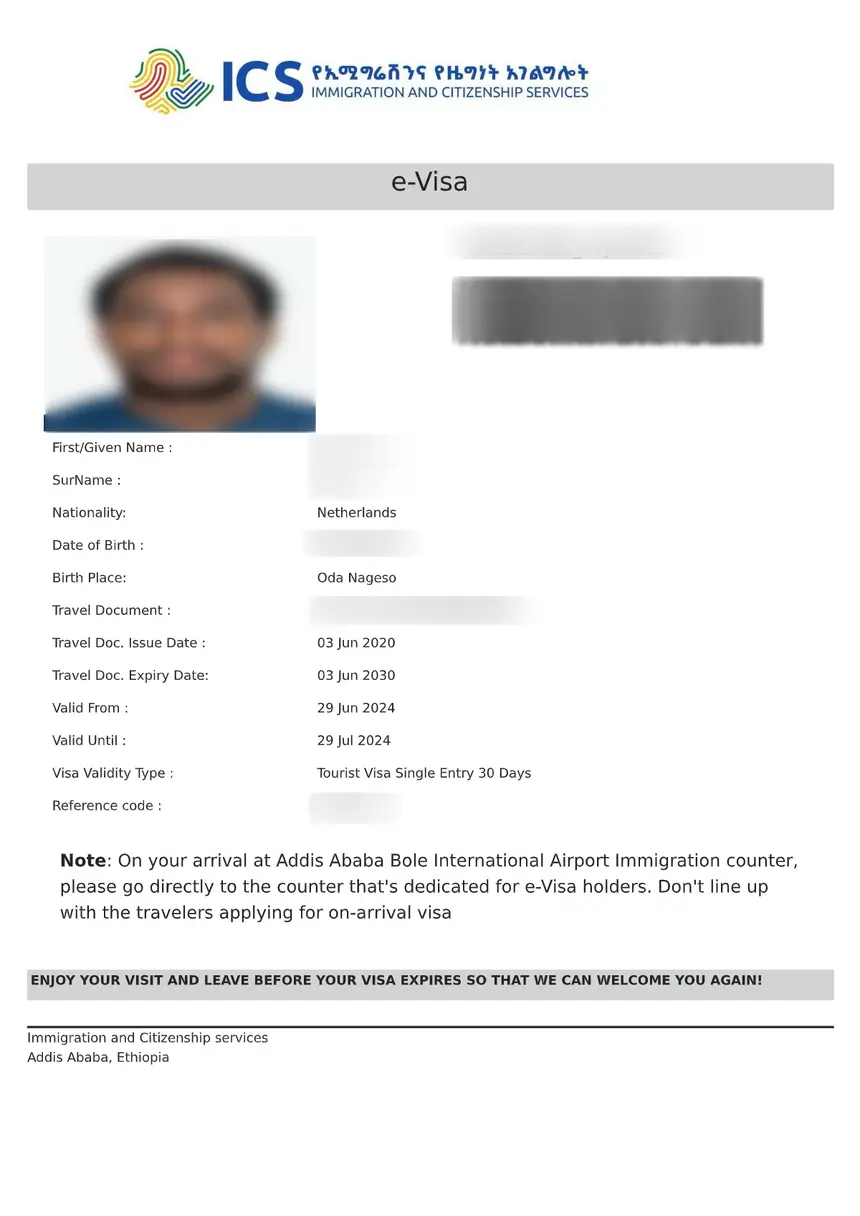
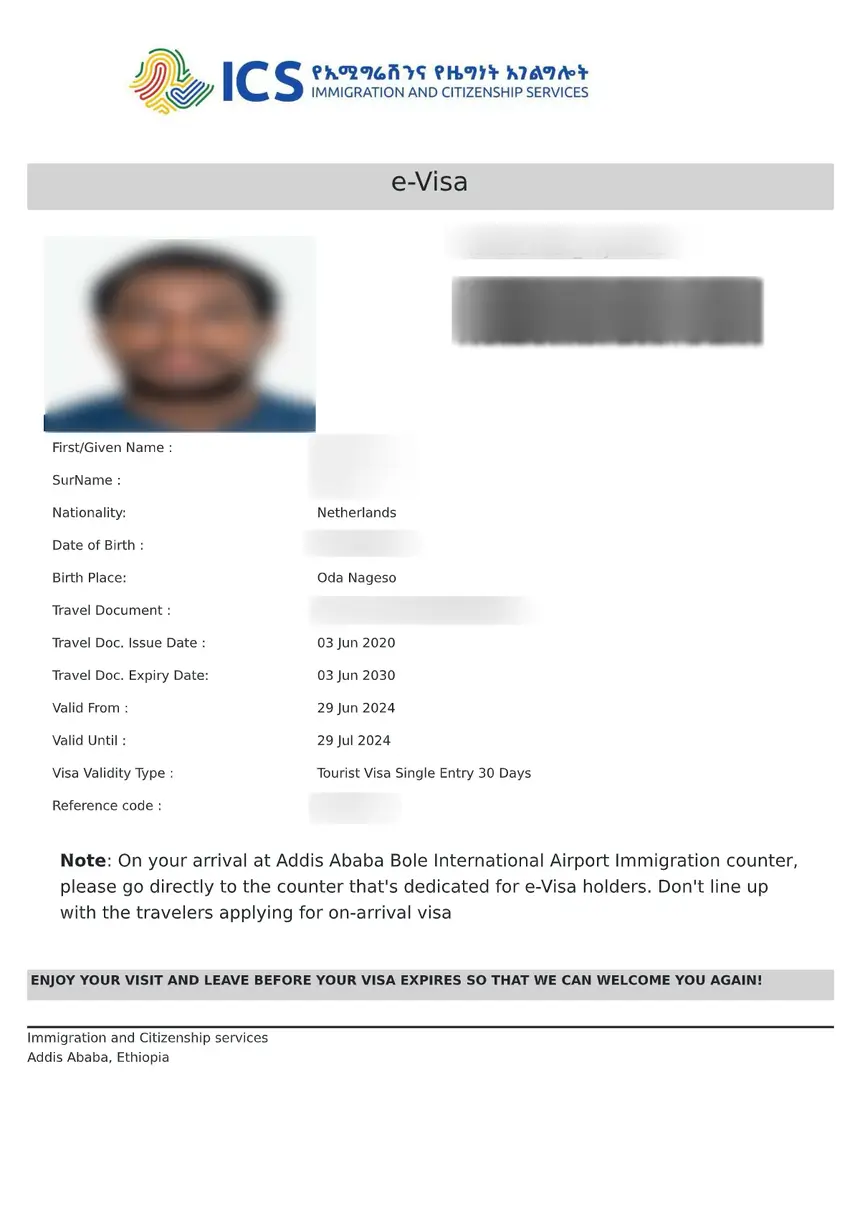
Processing takes up to 3 business days. You will receive an email notification when your e-Visa is approved. Download and print the e-Visa for presentation at the immigration counter upon arrival. For a detailed walkthrough of the general application process, see our Ethiopia visa application guide.
Investment Visa vs Business Visa: Key Differences
The Investment Visa and the Business Visa (BRV) are frequently confused. Here is a clear comparison:
| Feature | Investment Visa (IV) | Business Visa (BRV) |
|---|---|---|
| Purpose | Active investment in Ethiopia | Meetings, conferences, trade events |
| Required documentation | EIC letter + Embassy support letter | Reference code from host organization |
| Typical duration | 90 days to 12 months | 30 to 90 days |
| Can be extended | Yes, through ICS | Yes, through ICS |
| Employment allowed | No (separate work visa needed) | No |
| Investment Commission involvement | Required | Not required |
The Investment Visa is the right choice if your primary reason for entering Ethiopia is to establish, manage, or expand an investment. If you are attending a conference, meeting a potential partner, or exploring options without a formal EIC engagement, the Business Visa is more appropriate. For a full overview of all available categories, see our Ethiopia visa types guide.
Where to Enter Ethiopia on an Investment e-Visa
All e-Visa holders, including Investment Visa holders, must enter Ethiopia through Addis Ababa Bole International Airport (ADD). This is the only port of entry that processes e-Visas.
If you need to enter through a land border crossing or a regional airport, you must apply for a traditional visa sticker through an Ethiopian Embassy or Consulate before traveling. See our Ethiopia Embassy Visa guide for details on that process.
Upon arrival at Bole International Airport, proceed to the immigration counter with your printed e-Visa and passport. Keep your EIC documentation accessible – immigration officers may ask to see proof of your investment status.
Ethiopia’s Investment Sectors and Opportunities
Ethiopia’s Investment Proclamation identifies priority sectors where foreign investors receive incentives such as tax holidays, duty-free imports of capital goods, and land lease privileges. The main sectors open to foreign investment include:
- Manufacturing – textiles, garments, leather goods, agro-processing, pharmaceuticals
- Agriculture – commercial farming, floriculture, livestock, fishery
- Energy – hydroelectric, solar, wind, and geothermal power generation
- ICT – software development, business process outsourcing, telecommunications infrastructure
- Tourism – hotels, lodges, resorts, eco-tourism, and cultural tourism facilities
- Infrastructure – industrial parks, logistics hubs, transport, and real estate development
The Ethiopian Investment Commission provides sector-specific guidance and can connect potential investors with relevant government agencies. Industrial parks such as Hawassa, Bole Lemi, and Kilinto offer plug-and-play infrastructure for manufacturers.
Investment Visa Extension
If your Investment Visa expires before your business is complete, you can apply for an extension:
- Expired 1 to 15 days: Apply for extension online through the e-Visa portal
- Expired more than 15 days: Visit the head office of the Immigration and Citizenship Service in Addis Ababa in person
Extension fees are $102 for a 30-day single-entry extension and $302 for a 90-day multiple-entry extension. Overstaying without an approved extension results in fines and may affect future visa applications. For detailed extension procedures, see our Ethiopia visa extension guide.
Important Rules for Investment Visa Holders
- No employment – The Investment Visa does not authorize you to work for an Ethiopian employer. If your investment requires operational management, apply for a work visa (WV or GIV) as well.
- Age restriction – Investment Visas are not issued to applicants under 18.
- EIC compliance – Maintain valid documentation from the Ethiopian Investment Commission. If your investment permit lapses, your visa status may be affected.
- Multiple entry flexibility – The 6-month and 12-month multiple-entry options allow you to travel in and out of Ethiopia without reapplying each time, which is ideal for investors managing ongoing projects.
- Residence permit – For stays exceeding 90 days, you may need to apply for a residence permit through the Immigration and Citizenship Service.
FAQs About Ethiopia Investment Visa
What is the difference between an Ethiopia Investment Visa and a Business Visa?
The Investment Visa (IV) is for individuals actively investing or exploring investment opportunities in Ethiopia, backed by documentation from the Ethiopian Investment Commission. The Business Visa (BRV) is for short-term business activities such as meetings, conferences, and trade events. The IV requires an EIC letter; the BRV requires a reference code from a host organization.
How much does the Ethiopia Investment Visa cost?
Fees range from $62 for a 30-day single-entry to $502 for a 12-month multiple-entry visa. Extension fees are $102 for 30 days and $302 for 90 days. All fees are paid in USD through the official e-Visa portal and are non-refundable.
Do I need an Ethiopian Investment Commission letter for the Investment Visa?
Yes. A letter from the Ethiopian Investment Commission (EIC) confirming your investment activity or intent is a mandatory requirement. Without it, your application will be processed as a standard business visa instead.
Can I work in Ethiopia on an Investment Visa?
No. The Investment Visa does not authorize employment. If you need to manage daily operations at your investment, you must also obtain a work visa (WV or GIV) through your Ethiopian entity.
How long does it take to process an Ethiopia Investment Visa?
Standard processing takes up to 3 business days through the official e-Visa portal at evisa.gov.et. Apply at least one week before your intended travel date to allow for any document verification delays.
Can I extend my Ethiopia Investment Visa?
Yes. If your visa expired 1-15 days ago, you can apply online. If more than 15 days have passed, you must visit the Immigration and Citizenship Service office in Addis Ababa. Extension fees are $102 for 30 days and $302 for 90 days.
What payment methods are accepted for the Ethiopia Investment e-Visa?
The official e-Visa portal accepts Visa, MasterCard, American Express, Google Pay, Alipay, WeChat Pay, and Union Pay. Payments from certain countries (including Cuba, Iraq, Sudan, Yemen, Somalia, North Korea, Afghanistan, South Sudan, and Syria) are not accepted by card.
Can my family travel with me on an Investment Visa?
Family members traveling with an Investment Visa holder need their own visas. Children under 18 are not eligible for Investment Visas and must apply for tourist visas. Spouses who are not co-investors also need tourist or business visas.
Which sectors can I invest in with an Ethiopia Investment Visa?
Priority sectors include manufacturing, agriculture, energy, ICT, tourism, and infrastructure. The Ethiopian Investment Commission offers sector-specific incentives such as tax holidays and duty-free capital goods imports for qualifying investments.
Is the Ethiopia Investment Visa fee refundable if my application is denied?
No. All e-Visa application fees are non-refundable regardless of the outcome. Ensure your documentation, especially the EIC letter and Embassy support letter, is complete before submitting.