
The Ethiopia embassy visa and the e-Visa serve different traveler profiles. The e-Visa is faster and cheaper for most tourists, but the embassy visa is the only option for certain nationalities, visa types, and situations where the online system is unavailable. This guide explains exactly when you need each one and how to decide.
Ethiopia Embassy Visa vs e-Visa: Key Differences
Both the embassy visa and the e-Visa allow you to enter Ethiopia legally, but they differ in cost, processing time, application method, and who can use them. The table below shows the main differences at a glance.
| Feature | Embassy Visa | e-Visa |
|---|---|---|
| Application method | In person at embassy/consulate | Online at evisa.gov.et |
| Cost | $60 (single entry) / $150 (multiple entry) | $62 (30-day) / $152 (90-day) |
| Processing time | 3-5 business days (varies by embassy) | Up to 3 business days |
| Validity | Up to 90 days, can request multiple entry | 30 or 90 days, single entry only |
| Entry points | Any port of entry | Addis Ababa Bole International Airport only |
| Best for | Multiple entry needs, certain nationalities, long stays | Most tourists, quick single-entry trips |
The e-Visa is the faster and more convenient option for most travelers. You can apply from anywhere with an internet connection, pay online, and receive approval by email. However, it only permits entry through Addis Ababa Bole International Airport.
The embassy visa is required in several specific situations that the e-Visa cannot cover. Understanding which one applies to you will save time and avoid problems at the border.
When You Need an Embassy Visa Instead of an e-Visa
There are several situations where the embassy visa is your only option or your better choice.
You need multiple entries. The e-Visa is single-entry only. If you plan to leave Ethiopia and return during the same trip — for example, visiting Djibouti or Kenya and coming back — the embassy visa with multiple-entry status is necessary. The multiple-entry embassy visa costs $150 and allows unlimited entries within its validity period.
Your nationality is not eligible for the e-Visa. While the e-Visa system covers most nationalities, some countries are not listed. If your nationality does not appear on the e-Visa portal, you must apply through an Ethiopian embassy or consulate in your country of residence.
You are entering Ethiopia by land. The e-Visa is only valid at Addis Ababa Bole International Airport. If you are crossing a land border — from Kenya, Djibouti, Somalia, South Sudan, Sudan, or Eritrea — you need an embassy visa or a visa on arrival at the land crossing (where available).
You need a visa type other than tourist. The e-Visa system only offers tourist visas. If you need a business visa, transit visa, work visa, diplomatic visa, or investment visa, you must apply through an embassy. Check our guide on Ethiopia visa types for a full breakdown of each category.
The e-Visa system is down or your application was rejected. Technical issues or processing rejections on the e-Visa portal can occur. In these cases, applying through an embassy is the backup option.
How to Apply for an Ethiopia Embassy Visa
The embassy visa application process is straightforward but requires more preparation than the online e-Visa.
Step 1: Find Your Nearest Ethiopian Embassy or Consulate
Ethiopia has embassies and consulates in major cities worldwide. The Ethiopian Ministry of Foreign Affairs maintains a list of diplomatic missions. Contact the embassy directly to confirm their specific requirements, as some consulates have additional local procedures.
Step 2: Gather Required Documents
Embassy visa requirements vary slightly by mission, but the standard documents include:
- Valid passport with at least 6 months remaining validity from your planned entry date
- Completed visa application form (available from the embassy or downloadable from their website)
- Two recent passport-size photos (white background, taken within the last 6 months)
- Proof of travel arrangements such as flight itinerary or booking confirmation
- Proof of accommodation such as hotel reservation or invitation letter
- Visa fee payment (cash, money order, or as specified by the embassy)
For business visas, you will also need an invitation letter from an Ethiopian company or organization. For transit visas, you need proof of onward travel within the validity period.
Step 3: Submit Your Application
Most embassies accept applications in person during specified hours. Some missions allow submission by mail or through a visa processing agency. Processing typically takes 3-5 business days, though some embassies offer same-day or next-day service for an additional fee.
Step 4: Collect Your Visa
Return to the embassy to collect your passport with the visa stamp, or provide a prepaid return envelope if mail submission was accepted. Verify all details on the visa sticker — name, dates, visa type — before leaving.
How the e-Visa Process Compares
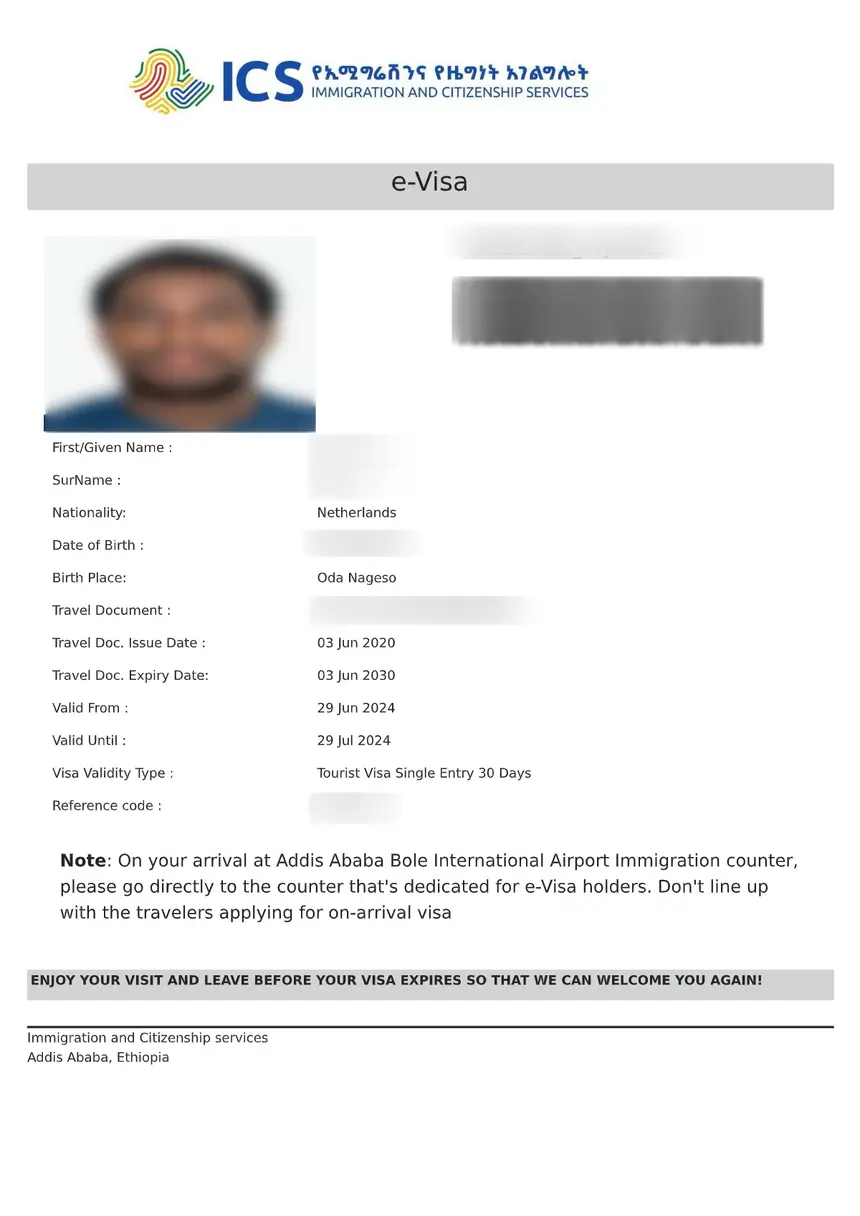
The e-Visa process is significantly simpler. You visit the official portal at evisa.gov.et, fill out the online form, upload a passport photo and passport scan, pay by credit or debit card, and wait up to 3 business days for approval. The e-Visa arrives by email as a PDF that you print and present at Bole International Airport.
For most tourists, the e-Visa is the recommended path. Our complete Ethiopia e-Visa guide covers the full application process step by step.
Embassy Visa vs e-Visa: Cost Comparison
The costs are similar, but the value depends on your travel plans.
| Visa Type | Embassy Cost | e-Visa Cost |
|---|---|---|
| 30-day single entry | $60 | $62 |
| 90-day single entry | $60 (standard) | $152 |
| Multiple entry | $150 | Not available |
The embassy visa is slightly cheaper for short stays and significantly cheaper for 90-day stays. However, the e-Visa avoids the time and travel cost of visiting an embassy. If you factor in the convenience of applying from home, the e-Visa’s small price premium is usually worth it for single-entry trips.
See our full breakdown of Ethiopia visa fees for current pricing across all visa types and nationalities.
Embassy Visa vs Visa on Arrival
Ethiopia also offers visa on arrival at Addis Ababa Bole International Airport for some nationalities. This is a third option that sits between the embassy visa and the e-Visa in terms of convenience.
The visa on arrival requires standing in line at the airport, filling out a form, and paying in cash (USD, EUR, GBP, or CAD only). The e-Visa lets you skip this queue entirely since your visa is pre-approved.
For a detailed comparison of all three options, read our guide on Ethiopia e-Visa vs visa on arrival.
Which Visa Should You Choose?
Use this simple decision framework:
Choose the e-Visa if:
– You are a tourist visiting once
– You are flying into Addis Ababa Bole International Airport
– You want the fastest and simplest process
– Your nationality is eligible on the e-Visa portal
Choose the embassy visa if:
– You need multiple entries
– You are entering by land border
– You need a non-tourist visa type
– Your nationality is not eligible for the e-Visa
– The e-Visa portal is experiencing issues
Choose visa on arrival if:
– You did not apply in advance and your nationality qualifies
– You are arriving at Bole International Airport
– You have USD, EUR, GBP, or CAD cash for the fee
Important Requirements for Both Visa Types
Whether you apply at an embassy or online, the following requirements apply to both:
- Your passport must have at least 6 months of validity remaining from your date of entry
- You need at least two blank pages in your passport for entry stamps
- You must have proof of onward or return travel
- Yellow fever vaccination certificate may be required if you are arriving from or transiting through a country with yellow fever risk
Check the full Ethiopia visa requirements to make sure you have everything before applying.
FAQs About Ethiopia Embassy Visa
Can I switch from an embassy visa to an e-Visa?
No. Each visa type is a separate application. If you already have an embassy visa, you do not need an e-Visa. If you want to change your visa type, contact the Main Department of Immigration and Nationality Affairs in Addis Ababa.
How long does it take to get an embassy visa for Ethiopia?
Processing time at most Ethiopian embassies is 3-5 business days. Some embassies offer expedited processing for an additional fee, which can reduce the wait to 1-2 business days. Contact your specific embassy for their current processing times.
Is the embassy visa more expensive than the e-Visa?
For 30-day stays, the embassy visa is slightly cheaper ($60 vs $62). For 90-day stays, the embassy visa is significantly cheaper ($60 vs $152). However, the e-Visa is more convenient since you can apply from home without visiting an embassy.
Can I get an embassy visa on arrival in Ethiopia?
No. Embassy visas must be obtained before you travel, from an Ethiopian embassy or consulate in your country of residence. Visa on arrival is a separate process handled at the airport.
Do I need an embassy visa if I have a layover in Ethiopia?
If you are staying in the international transit area and your layover is under 24 hours, you may not need a visa. If you plan to leave the airport, you need either an e-Visa, visa on arrival, or embassy visa depending on your nationality.
Can I extend an embassy visa while in Ethiopia?
Yes. You can apply for a visa extension at the Main Department of Immigration and Nationality Affairs in Addis Ababa. Extensions must be requested before your current visa expires. There is a fee for the extension, and overstaying your visa results in fines and possible detention.
What if my country does not have an Ethiopian embassy?
If there is no Ethiopian embassy in your country, check if there is an honorary consulate that handles visa applications. Alternatively, you may be able to apply at an embassy in a neighboring country, or use the e-Visa portal if your nationality is eligible.