

Planning a trip to Ethiopia and wondering whether to apply for an e-Visa online or get your visa when you land? Both options are available to most travelers, but they differ significantly in cost, convenience, processing time, and risk. This guide breaks down every difference so you can choose the right method for your trip.
Quick Comparison: e-Visa vs Visa on Arrival
| Feature | e-Visa | Visa on Arrival |
|---|---|---|
| Where to apply | Online at evisa.gov.et | Addis Ababa Bole International Airport |
| Advance approval | Yes – before you fly | No – decided at the airport |
| Processing time | Up to 3 business days | 30-60 minutes at the airport |
| Payment methods | Credit/debit card online | Cash only (USD, EUR, GBP, CAD) |
| 30-day tourist fee | $62 | $62 |
| 90-day tourist fee | $152 | $152 |
| Risk of denial | Before travel (low impact) | At the airport (high impact) |
| Entry point restriction | Bole International Airport only | Bole International Airport only |
| Business visa available | Yes | Limited |
| Transit visa available | Yes | No |
What Is the Ethiopia e-Visa?
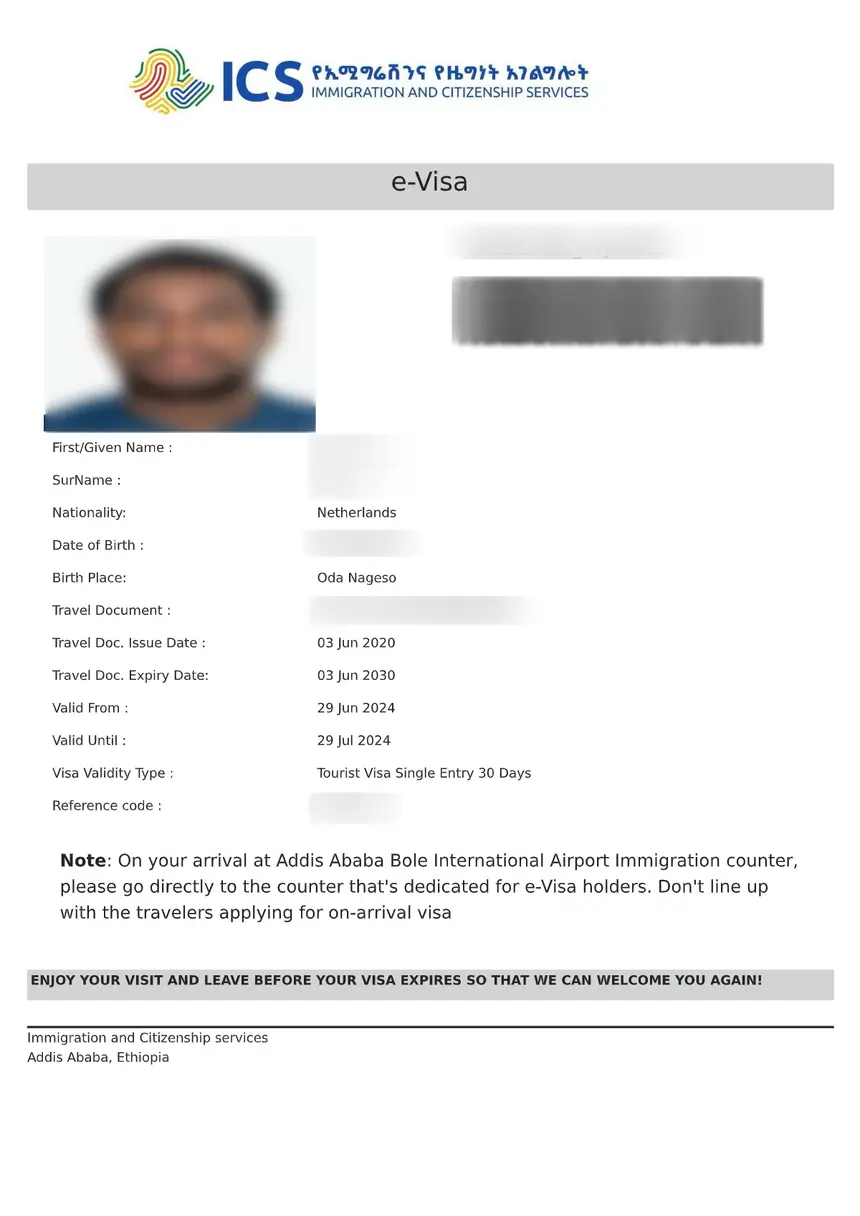
The Ethiopia e-Visa is an electronic visa that you apply for entirely online through the official Ethiopian government portal at evisa.gov.et. You fill out the application form, upload your passport photo and passport bio page, pay by credit or debit card, and receive your approved visa by email – usually within three business days.
The e-Visa was introduced in 2017 to modernize Ethiopia’s visa process and reduce congestion at the airport. It is now the recommended method for most travelers.
Key advantages of the e-Visa
- Guaranteed before you fly – You know your visa is approved before booking your flight or boarding the plane.
- Online payment – No need to carry large amounts of cash.
- Faster airport arrival – With an approved e-Visa, you proceed directly to immigration – no additional paperwork or queues at the visa desk.
- Multiple visa types – You can apply for tourist, business, transit, and investment visas online.
- Printable confirmation – You carry a physical or digital copy of your approval, reducing uncertainty.
What Is the Ethiopia Visa on Arrival?
The Visa on Arrival (VOA) is a visa issued at Addis Ababa Bole International Airport when you land. You fill out a form at the airport visa counter, present your documents, pay in cash, and receive your visa stamp before proceeding to immigration.
Key advantages of the Visa on Arrival
- No advance planning required – Useful for last-minute trips or spontaneous travel.
- Same-day decision – No waiting for email approval.
- No internet access needed – You do not need to complete an online application.
Detailed Comparison
1. Application Process
e-Visa: Visit evisa.gov.et, create an account, fill in personal and travel details, upload a passport-style photo and a scan of your passport’s bio page, select your visa duration (30 or 90 days), pay online, and submit. You receive an email confirmation and can download your e-Visa approval letter.
Visa on Arrival: Land at Bole International Airport, join the visa-on-arrival queue, fill out a paper form, submit your passport and one passport photo, pay in cash, and wait for processing. The entire process typically takes 30 to 60 minutes but can take longer during peak hours.
2. Cost
Both options charge the same official fees:
| Visa Type | Duration | Fee |
|---|---|---|
| Tourist (single entry) | 30 days | $62 |
| Tourist (single entry) | 90 days | $152 |
| Business | 30 days | $62 |
| Business | 90 days | $152 |
| Transit | 72 hours | $32 |
Hidden costs to consider:
- Visa on Arrival requires exact cash in USD, EUR, GBP, or CAD. If you only have other currencies, you may face unfavorable exchange rates at the airport.
- e-Visa payments are made by card online, so you avoid currency exchange issues entirely.
3. Processing Time
e-Visa: The official processing time is up to three business days, though many travelers report receiving approval within 24 hours. During busy periods or holidays, it may take the full three days.
Visa on Arrival: Processing at the airport usually takes 30 to 60 minutes. However, during peak travel seasons (September to January, around Ethiopian holidays), queues can be significantly longer.
4. Risk and Peace of Mind
This is where the two options differ most.
e-Visa: If your application is denied, you find out before your trip. You can address the issue – submit additional documents, correct errors, or apply through an embassy – without being stranded at an airport in a foreign country.
Visa on Arrival: If your visa is denied at the airport, you face immediate consequences: potential deportation, being placed on a return flight, and significant stress and expense. While denials are rare, the stakes are much higher.
5. Who Qualifies?
e-Visa: Available to citizens of all countries except those who are visa-exempt or require prior approval from an Ethiopian embassy. Most nationalities, including US, UK, Indian, Pakistani, Nigerian, and all EU citizens, are eligible.
Visa on Arrival: Available to citizens of most countries, though eligibility can change without notice. Some nationalities may not qualify for VOA and must apply for an e-Visa or embassy visa in advance.
6. Visa Types Available
e-Visa: Tourist (30 or 90 days), business, transit (72 hours), and investment visas are all available online.
Visa on Arrival: Primarily tourist visas. Business and transit visas may not always be available at the airport counter.
7. Entry Point Restriction
Both the e-Visa and the Visa on Arrival are valid only at Addis Ababa Bole International Airport. If you are entering Ethiopia through a land border (e.g., from Kenya, Sudan, Djibouti, or Somalia) or through a different airport, you must obtain a visa from an Ethiopian embassy or consulate before traveling.
When to Choose the e-Visa
The e-Visa is the better choice in almost every situation. Choose it when:
- You want certainty – Knowing your visa is approved before you fly removes a major source of travel anxiety.
- You are flying into Addis Ababa Bole International Airport – This is the only entry point for both options, so the e-Visa is optimized for this.
- You need a business or transit visa – These are more reliably available online than at the airport.
- You do not want to carry large amounts of cash – e-Visa payment is online by card.
- You are traveling during peak season – Airport queues can be long; an e-Visa lets you skip the visa desk entirely.
- You have a tight connection – If your layover is short, the e-Visa eliminates the risk of missing a connecting flight due to visa processing delays.
When to Choose Visa on Arrival
The Visa on Arrival makes sense in limited circumstances:
- Last-minute travel – If you are flying within the next few days and do not have time to wait for e-Visa processing.
- Spontaneous trip changes – If your travel plans change unexpectedly and you decide to visit Ethiopia.
- Technical issues – If the e-Visa portal is temporarily down or you are experiencing difficulties with the online application.
- You prefer in-person processing – Some travelers simply prefer handling official documents face-to-face.
Common Mistakes to Avoid
With the e-Visa
- Applying too late – Apply at least one week before your trip. While many approvals come within 24 hours, processing can take up to three business days.
- Wrong passport details – Double-check your passport number, name spelling, and date of birth. Errors can lead to denial or problems at immigration.
- Low-quality photo upload – Blurry or improperly formatted photos are a common reason for application delays.
- Not printing the approval – While a digital copy on your phone works, carrying a printed copy is a reliable backup.
With the Visa on Arrival
- Not carrying enough cash – VOA requires exact cash in USD, EUR, GBP, or CAD. ATMs at the airport may not always work for foreign cards.
- Forgetting passport photos – You need one passport-sized photo for the VOA application. Bring extras just in case.
- Assuming eligibility – Visa on arrival policies can change. Verify your nationality is eligible before relying on this option.
- Peak hour delays – Arriving during busy hours (early morning, late evening) can mean longer wait times.
Frequently Asked Questions
Can US citizens get a visa on arrival in Ethiopia?
Yes, US citizens can obtain a visa on arrival at Addis Ababa Bole International Airport. However, applying for an e-Visa in advance is strongly recommended to avoid potential delays and to guarantee entry before you travel.
How much does an Ethiopian e-Visa cost?
A 30-day single-entry tourist e-Visa costs $62. A 90-day single-entry tourist e-Visa costs $152. Business visas are the same price.
How long does it take to get an Ethiopian e-Visa?
The official processing time is up to three business days. Most applicants receive approval within 24 hours.
Is the visa on arrival available at all Ethiopian airports?
No. The visa on arrival is only available at Addis Ababa Bole International Airport. If you enter Ethiopia through a land border or another airport, you need a visa from an embassy or an approved e-Visa.
Can I extend an e-Visa or visa on arrival in Ethiopia?
Yes, you can extend your visa at the Main Department of Immigration and Nationality Affairs in Addis Ababa. Extensions should be applied for before your current visa expires to avoid overstay penalties.
Which is safer – e-Visa or visa on arrival?
The e-Visa is safer because you know your visa status before you travel. If denied, you can address the issue without the risk of being turned away at the airport.
Recommendation
For most travelers, the e-Visa is the clear winner. It costs the same as the visa on arrival, gives you advance certainty, lets you skip airport queues, and accepts card payments. Apply at least one week before your trip at evisa.gov.et for the smoothest possible arrival in Ethiopia.
The visa on arrival remains a useful backup for last-minute travel, but it should not be your first choice when an e-Visa is an option.